Left ventricular mass and volume (size)
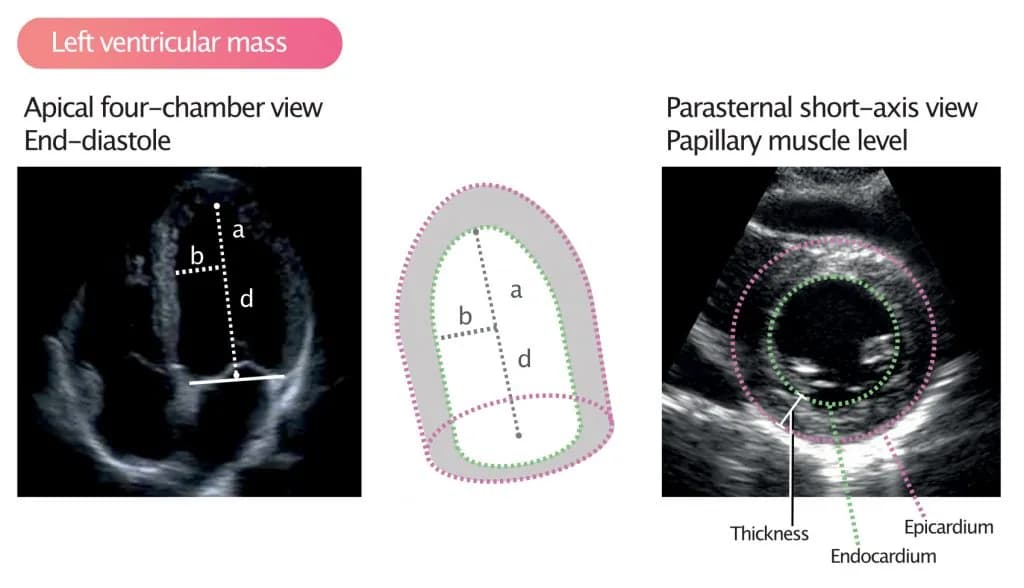
Size and mass of the left ventricle Left ventricular mass is a flawed proxy for ventricular systolic function and load. The mass is, however, an important parameter in the…
Size and mass of the left ventricle
Left ventricular mass is a flawed proxy for ventricular systolic function and load. The mass is, however, an important parameter in the assessment of ventricular hypertrophy and cardiomyopathy. Numerous formulas have been developed to approximate ventricular mass. Most formulas are simple mathematical equations, included in all ultrasound systems, and assume that the geometry of the left ventricle is normal.

Figure 1. Calculation of left ventricular mass.
massLV = 1.05 (masstotal – masscavity) LV = left ventricle; 1.05 = mycoardial mass constant.
Left ventricular hypertrophy (LVH)
A diagnosis of left ventricular hypertrophy is based on total left ventricular mass, which can be calculated by obtaining the measurements shown in Figure 1. The ultrasound system automatically calculates RWT (Relative Weight Thickness), provided that the patient's weight, height and sex are entered. RWT is a measure of the type of hypertrophy.
Generally, hypertrophy is defined as wall thickness exceeding 12 mm. Thus, wall thickness >12 mm should raise suspicion of hypertrophy.
Assessing left ventricular systolic function
Methods for assessing systolic function (contractile function) Several echocardiographic measurements are available to assess left ventricular systolic function. These methods…
Ejection fraction (EF): Physiology, Measurement & Clinical Evaluation
Ventricular ejection fraction (EF) For several decades, ejection fraction (EF) has been the dominating method for assessing left ventricular systolic function. Ejection fraction…