First-degree AV block (AV block I, AV block 1)
First-degree AV block: ECG criteria, clinical characteristics & management
This chapter discusses first-degree atrioventricular (AV) block, also referred to as 1st-degree AV block, AV block I, or AV block 1. Before proceeding, it is recommended to review the basic concepts of AV blocks (refer to Introduction to AV Blocks). The term block is somewhat imprecise in the context of first-degree AV block, as it does not represent a true conduction block but rather a delay in the propagation of electrical impulses from the atria to the ventricles. This delay is characterized by a prolonged PR interval on the ECG, defined as a PR interval ≥0.22 seconds. Importantly, all P-waves are followed by QRS complexes. First-degree AV block is rarely of clinical significance and typically does not require intervention. In most cases, the conduction delay is localized to the atrioventricular node.
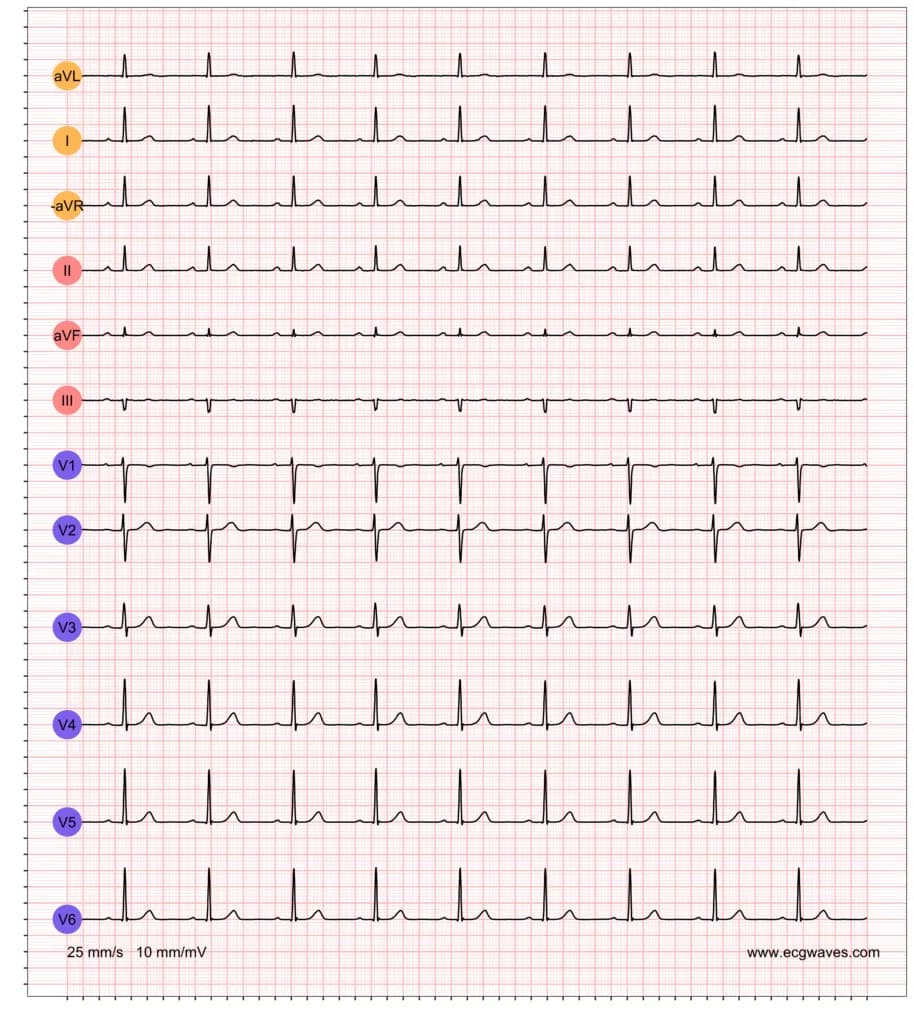
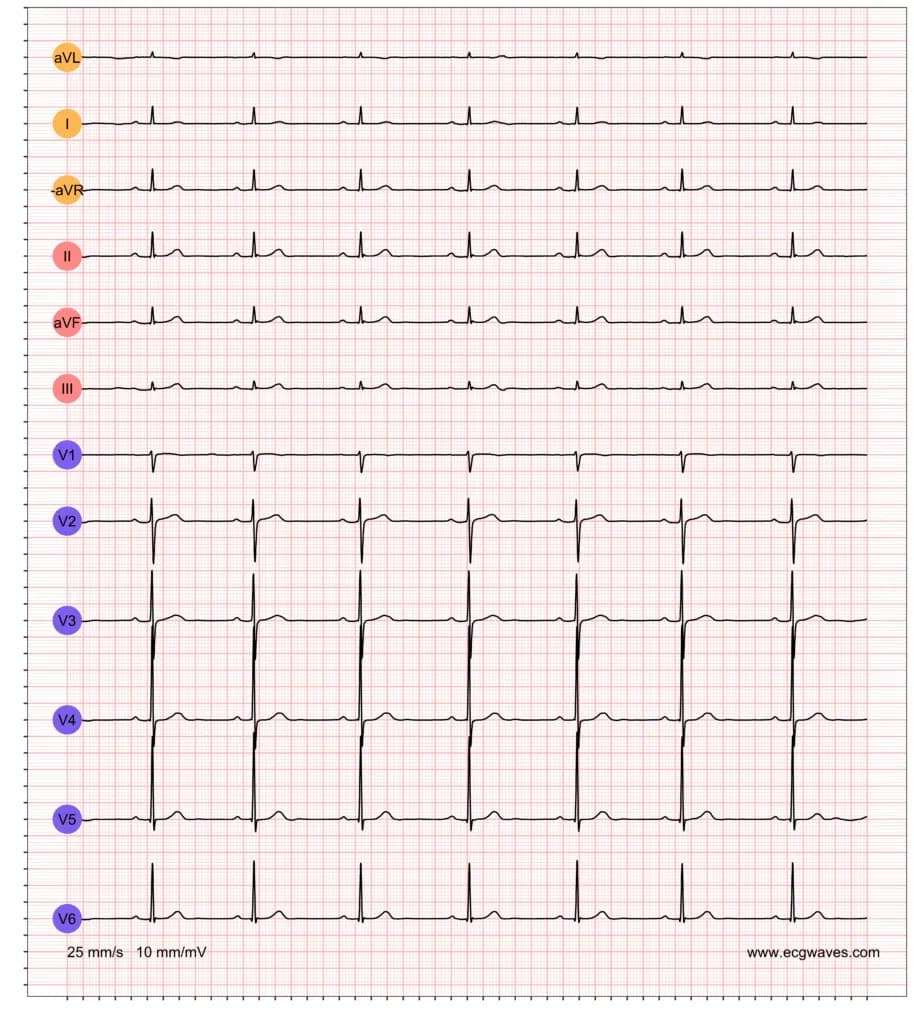
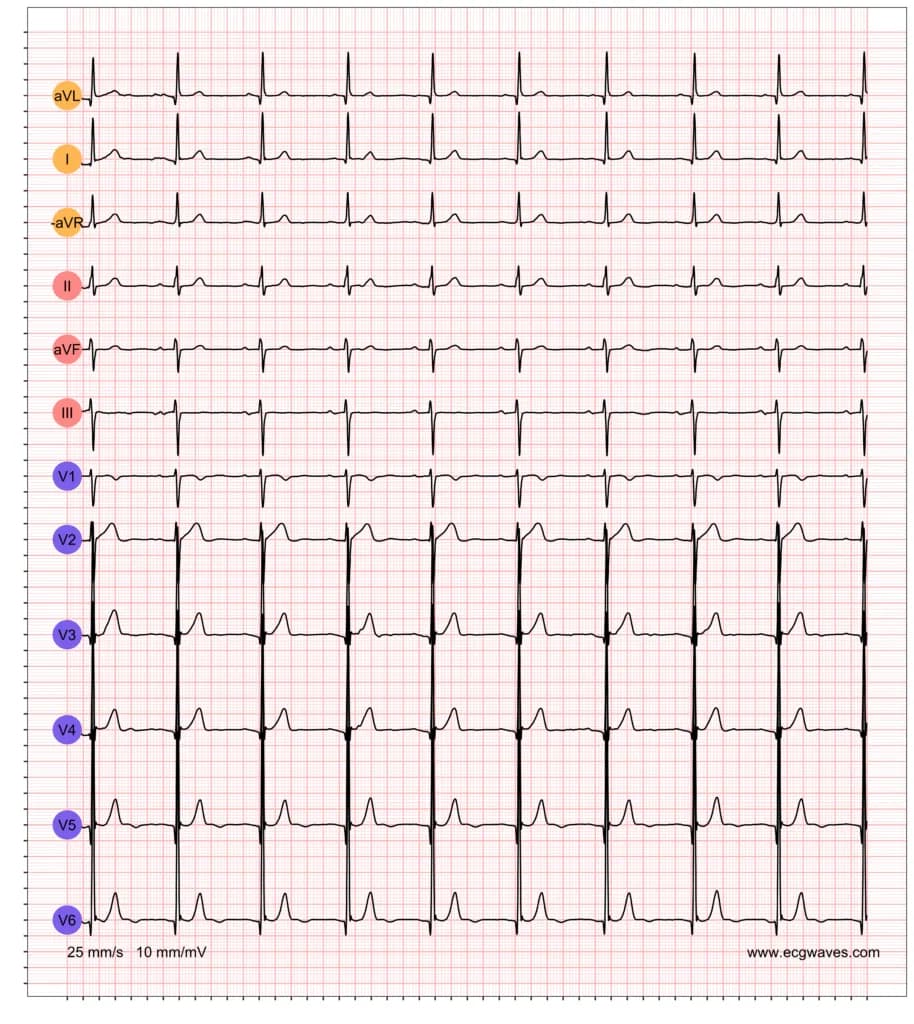
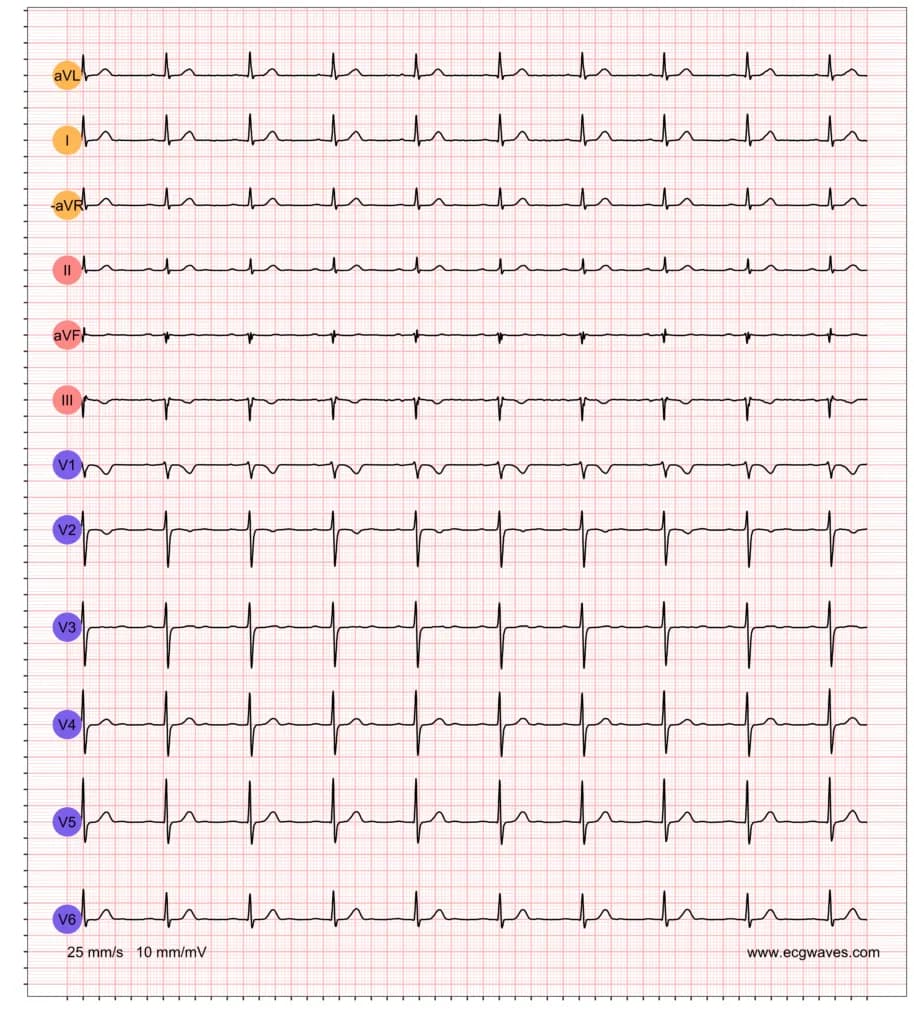
ECG examples of first-degree atrioventricular block (AV block 1). Click to zoom.
ECG criteria for first-degree AV block
- PR interval ≥0,22 s.
- All P-waves are followed by QRS complexes.
First-degree AV block with wide QRS complex
First-degree AV block with normal QRS complex (QRS duration <0.12 s) is localized in the AV node in 90% of the cases and the bundle of His in 10% of cases. If the ECG displays first-degree AV block (PR interval ≥0,22 s) along with wide QRS complexes (QRS duration ≥0,12 s) there is a high probability that the block is located bilaterally in the bundle branches. This type of first-degree AV block often progresses to third-degree (complete) AV block, and therefore necessitates an artificial pacemaker.
Blocks located proximal to the AV node (prenodal blocks)
First-degree AV block may actually be due to the slowing of impulse conduction prior to the AV node. This is mostly due to fibrosis of atrial myocardium. The ECG shows, besides prolonged PR interval, wide P-waves with low amplitude. Prenodal block is, however, uncommon.
Prognosis of first-degree AV block
Isolated first-degree AV block with normal QRS complexes has very good prognosis and may even occur in otherwise healthy individuals. However, if the QRS complexes are wide there is a risk of distal block which may progress to more advanced block (second- or third-degree AV block). A pacemaker is often necessary in individuals with first-degree AV block and wide QRS complexes.
Treatment of first-degree AV block
Refer to Management of Atrioventricular (AV) Blocks
Overview of atrioventricular (AV) blocks
This article covers the fundamental principles of atrioventricular AV blocks, which are classified into three types: first-degree, second-degree, and…
Second-degree AV block: Mobitz type 1 (Wenckebach) & Mobitz type 2 block
In this chapter, the focus will be on second-degree atrioventricular AV block. Before proceeding, it is advised to review the introductory chapter on AV…