Inotropes and Vasopressors: Doses, indications, contraindications and effects
Inotropes and vasopressors
Vasopressors induce vasoconstriction and increase mean arterial pressure (MAP). Inotropes increase cardiac contractile force (contractility). Several endogenous and synthetic agents exist and are frequently combined to achieve the desired hemodynamic outcome. Most agents exhibit both vasopressor and inotropic effects (Figure 1). Below follows a drug manual for use in the CCU (coronary care unit), ICU (intensive care unit) or ER (emergency room). Careful electrocardiographic and hemodynamic monitoring with ECG, central vein catheter and intra-arterial catheter (A-line) is warranted.
Overview of vasopressors and inotropes
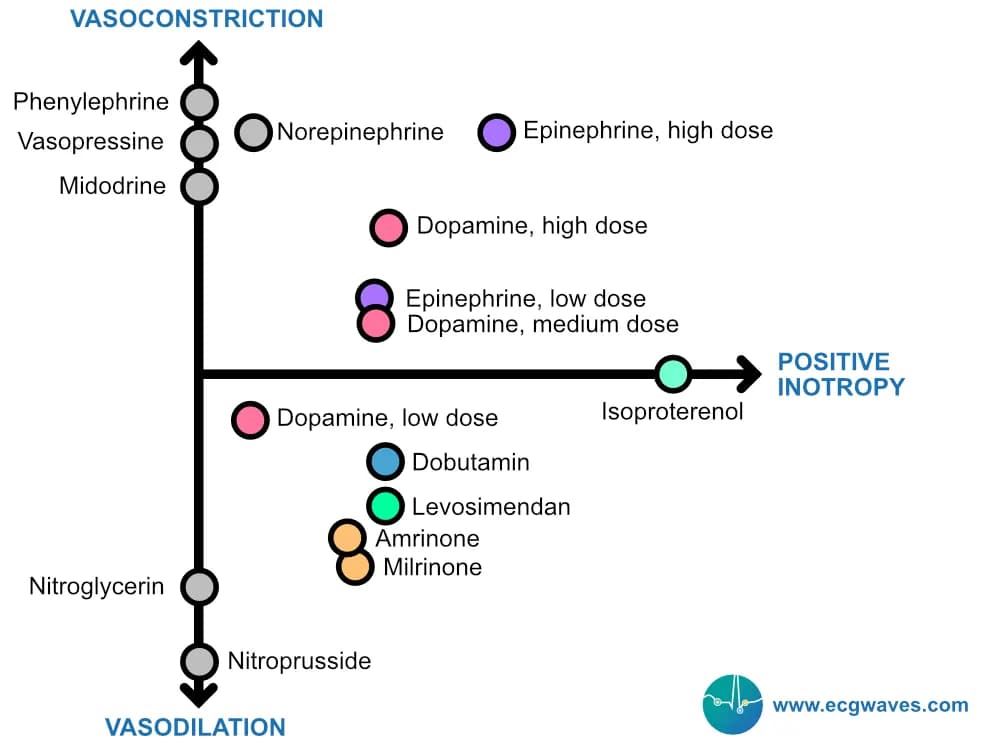
Inotropes and vasopressors.
Table 1. Drug manual for inotropes and vasopressors
| Drug | Indications | Dose | α1 effect | β1 effect | β2 effect | D1/D2 effect | Result | Side Effects |
|---|---|---|---|---|---|---|---|---|
| Dopamine - low dose | Rarely used | Low dose: 0.5-3.0 μg/kg/min | + | + | + | +++++ | Low dose dopamine stimulates D1 receptors and induces vasodilation in coronary, renal, cerebral and mesenteric vessels. | Few |
| Dopamine - medium dose | Cardiogenic shock | |||||||
| Vasodilatory shock | ||||||||
| Heart failure (HF), acute | ||||||||
| Heart failure (HF), chronic | ||||||||
| Bradycardia (second-line alternative) | Medium dose: 3.0-10.0 μg/kg/min. | + | ++++ | + | +++++ | Medium dose dopamine activates β1, releases norepinephrine and thus increases contractility, chronotropy and mild increase in SVR. | Ventricular arrhythmias | |
| Myocardial ischemia Tissue ischemia (high doses or extravasation) | ||||||||
| Dopamine - high dose | Cardiogenic shock | |||||||
| Vasodilatory shock | ||||||||
| Heart failure (HF), acute | ||||||||
| Heart failure (HF), chronic | ||||||||
| Bradycardia (second-line alternative) | High dose: 10.0-20.0 μg/kg/min. | ++++ | ++++ | ++ | +++++ | Hig dose dopamine additionally induces α1 stimulation and thus vasoconstruction and pronounced increase in SVR. | As medium dose, and additionally severe hypertension (caution if patient on nonselective beta-blockers). | |
| Dobutamine | Cardiogenic shock | |||||||
| Bradycardia (second-line therapy) | ||||||||
| Stress testing (due to induced increase in myocardial O2 consumption) | Regular: 2.0–20 μg/kg/min | |||||||
| Max: 40 μg/kg/min | + | +++++ | +++ | 0 | Potent inotrope with slight chronotropic effect. Doses <5 μg/kg/min induces mild vasodailation. | |||
| Doses >5 μg/kg/min induces vasoconstriction, which dominates at dosease >15 μg/kg/min. | Tachycardia | |||||||
| Increased ventricular rate in AF | ||||||||
| Ventricular arrhythmias | ||||||||
| Cardiac ischemia Hypertension (in patients on nonselective β-blocker) | ||||||||
| Tolerance after a few days | ||||||||
| Norepinephrine | Shock (any) | |||||||
| Hypotension (any) | 0.01–3.0 μg/kg/min |
Safe for peripheral use | +++++ | +++ | ++ | 0 | Potent vasoconstrictor with mild inotropic effect. Increases systolic pressure, diastolic pressure and pulse pressure with minimal effect on CO. Minimal chronotropic effect. Increases coronary blood flow. | Atrial or ventricular arrhythmias
Bradycardia
Peripheral (digital) ischemia
Hypertension (especially nonselective β-blocker patients)
Prolonged use may be cardiotoxic. |
| Epinephrine | Shock (any)
Cardiac arrest
Bronchospasm
Anaphylaxis
Bradycardia (second-line alternative) | Infusion: 0.01 to 0.10 μg/kg/min
Bolus: 1 mg IV every 3 to 5 min (max 0.2 mg/kg) IM: (1:1000): 0.1 to 0.5 mg (max 1 mg)
Safe for peripheral use | +++++ | ++++ | +++ | N/A | Beta-effect more pronounced at low doses. Alpha-effect pronounced at higher doses. Coronary flow enhanced.
Pulm vasoconstriction.
Increased pulmonary blood flow. | Ventricular arrhythmias Severe hypertension resulting in cerebrovascular hemorrhage Cardiac ischemia Sudden cardiac death
Prolonged use may be cardiotoxic. |
| Isoproterenol | Bradycardia (first-line therapy)
Bradycardia causing torsade de pointes
Brugada syndrome | 2.0–10.0 μg/min
Safe for peripheral use | 0 | +++++ | +++++ | 0 | Powerful chronotropic and inotropic effect. Potent systemic vasodilation. Mild pulmonary vasodilation. No effect on CO. | Ventricular arrhythmias Cardiac ischemia Hypertension Hypotension |
| Phenylephrine | Typically used as emergency bolus to correct acute hypotension.
Hypotension (any)
Used to increase MAP during hypotension in aortic stenosis.
Used to decrease LVOT gradient in HCM
Used to correct hypotension caused by the simultaneous ingestion of sildenafil and nitrates | Bolus: 0.1 to 0.5 mg IV every 10 to 15 min
Infusion: 0.4 to 9.1 μg/kg/min
_
Safe for peripheral use_ | +++++ | 0 | 0 | N/A | Immediate and pronounced increase in MAP. | Reflex bradycardia Hypertension (especially with nonselective β-blockers)
Severe peripheral and visceral vasoconstriction Tissue necrosis with extravasation |
| Milrinone (Phosphodiesterase Inhibitor) | Heart failure, acute
Heart failure, decompensated chronic. | Bolus: 50 μg/kg bolus over 10 to 30 min
Infusion: 0.375 to 0.75 μg/kg/min. | 0 | 0 | 0 | 0 | PDI (Phosphodiesterase Inhibitor).
Potent inotrope.
Induces vasodialtion.
Results in reduced preload, afterload and SVR. | Ventricular arrhythmias Hypotension
Myocardial ischemia
Torsade des pointes
Accumulates in renal failure (dose adjustment necessary) |
| Amrinone | Heart failure, acute
Heart failure, decompensated chronic | Bolus: 0.75 mg/kg over 2 to 3 min Infusion: 5 to 10 μg · kg−1 · min−1 | 0 | 0 | 0 | 0 | PDI (Phosphodiesterase Inhibitor). Rarely used due to side effects. | Arrhythmias, enhanced AV conduction
Hypotension Thrombocytopenia Hepatotoxic |
| Vasopressin | Shock (any)
Cardiac arrest | Infusion: 0.01–0.1 U/min (common fixed dose 0.04 U/min)
Bolus (IV): 40 U | 0 | 0 | 0 | 0 | Vasopressin stimulates V1 receptors (vascular smooth muscle) and V2 (renal). V1 stimulation induces vasoconstriction, and V2 increases renal water reabsorption. Vasopressin increases SVR with no significant effect on CO. Vasopressin potentiates the vascular effect of norepinephrine. | Arrhythmias Hypertension Decreased CO (at doses >0.4 U/min) Cardiac ischemia Severe peripheral vasoconstriction causing ischemia (especially skin) Splanchnic vasoconstriction |
| Levosimendan | Heart failure, decompensated chronic | Loading dose: 12–24 μg/kg over 10 min
Infusion: 0.05–0.2 μg/kg/min | 0 | 0 | 0 | 0 | Levosimendan is a calcium sensitizer that
enhances ventricular contractility and induces peripheral arteriolar and venous vasodilation. | Enhanced AV conduction
Hypotension |
CO = cardiac output, AF = atrial fibrillation, SVR = systemic vascular resistance, MAP = mean arterial pressure.
Receptors of catecholamines
- Alpha-1 adrenergic receptors: expressed in vascular smooth muscle cells, activation leads to vasoconstriction and increased SVR.
- Beta-1 adrenergic receptors: expressed in the myocardium; excitation results in increased contractile force (contractility) and increased chronicity.
- Beta-2 adrenergic receptors: expressed in the vascular smooth musle cells and leads to vasodilation.
- D1 and D2 (Dopamine receptors): Excitation of D1 and D2 dopaminergic receptors in the kidney and splanchnic vasculature induces renal and mesenteric vasodilation.
NB: Rapid blood pressure alterations may induce reflexive autonomic responses that affect the final hemodynamic result.
Dobutamine is a synthetic catecholamine.
References
Antiarrhythmic drugs in ventricular tachyarrhythmias
This manual presents recommendations for the management of ventricular tachyarrhythmias VT, VF. It is primarily intended for use in an emergency setting.…
Levosimendan (Simdax, Simendan) in acute heart failure
Levosimendan exhibits both inotropic and vasodilatory effects. The drug exerts its effects through three pharmacological mechanisms: 1 augmentation of…